Mysh bzi. Hallo.
Moremble.
Salaam. Hola. Ciao.
Guten Tag. Namaste. Konnichi Wa.
Bonjour. Salut. Chao.
Hello there, and welcome to my pseudo-ethnic greeting; a place where I pretend for just a moment that I am, in fact, perfectly capable of listing all of these diverse forms "hello" off the top of my head, and that I didn't, in fact, type "hello in many languages" into Google search.
And now we return to reality.
Today, Angie Chuang, a professor of ethnic journalism at American University, spoke to us about - you guessed it - ethnic journalism.
It's so funny, because despite all my talk of being overwhelmed by the amount of diversity in D.C., until today I never once thought about how all of these multi-ethnic groups deal with journalism and the news. It was really eye-opening to hear about all of the different ways that ethnic journalism can be approached. There's so much variety in who commissions it, who writes it, who it's aimed at, who reads it and the areas and issues it covers.
Ethnic media also serves an essentially different purpose than "mainstream media" - whether it be 'immigrant media' or 'minority media' (minority often being a sort of falsity in itself), and Angie spent a lot of time talking about some of the deeper differences inherent its approach.
Journalists often claim that they are not out to change anything - and if they are, it is only in the sense that by exposing something it will in turn affect people. Their mission is not to alter the state of events. However, ethnic media is more concerned with enacting change. A lot of the articles address an issue, and serve as a sort of "how-to" guide for how to deal with it.
For example, before today's class we read an example of an article that highlighted institutions' propensity not to hire those with "African-American sounding names", and it essentially explained how to better ensure being hired if your given-name falls within this category.
Angie asked us to think about how this article would fare if placed in, say, The Washington Post. She said people would be outraged, because it assumes that the state of things are as it says, and provides very little contrasting data or observations. It doesn't approach the issue in a 100% objective method, something that more mainstream publications are supposed to always do .
This however, she says, is just how ethnic journalists write - they look and write from inside a community, rather than from an outside perspective.
Because they're writing for a specific audience with specific needs, they approach topics in a manner that consists of less plain explanation, and more advice-like qualities on how to deal with day-to-day issues that their readership faces.
It was great to hear her speak, especially since she has so much experience in the area - and I'm definitely going to pick up an ethnic publication next time I see one, if only to see what types of issues it speaks about.
I also came away from today with an appreciation of some of the difficulties of being a member of a "minority" group and working in journalism. People always expect you to know and to want to write about your respective ethnicity - and I think that would get incredibly tedious. Angie seemed to deal with it really well, but I know that I'd get really sick of people's assumptions. I guess that would apply to all areas of my life, though, and not just my journalistic duties.
So go read El Tiemo Latino and expand your horizons!
Ciao.
Ps: I totally failed today and forgot to take a picture - I was a wee bit distracted (read: I was about to go shopping). So here's a picture of Angie Chuang for your reference, courtesy of AU's website [you go ahead and feel free to mentally photoshop some cute journalism students in behind her - your imagination could use a little practice anyhow]
Monday, October 11, 2010
Tuesday, October 5, 2010
'State Beverage: Milk, The perfect complement to cookies'
I used to hate meeting people from my home state. Seriously, I'd avoid Wisconsin natives like the plague. God forbid some of their Midwestern-ness would rub off on me, or even worse, that they'd expose me as being from....ugh, Wisconsin. Yuck.
Therefore, I've gotten pretty good at pretending I'm from some cooler, big city - especially since I apparently have a permanent, cheer-repelling 'stink-face' - if I take into consideration the first impression of every person who's ever met me.
But lately, I've been all proud of my nerdy, hick-heritage. Now, when I meet people from Wisconsin, I'm like, "You're from Wisconsin?! REPRESENT! Do you like cows??! I totally love cows! And isn't cheese, like, the greatest!? And couldn't you just watch the opening credits from "That 70's Show" all day long?? God, our homestate is the best, right?!"
I know. It's shameful. I honestly don't know what's gotten into me. All of a sudden I've become this disgustingly staunch advocate of midwestern culture.
Anyhow, this little guilt-ridden rant does in fact relate to our guest speaker today, who was, if it hasn't already been made painfully obvious, from Wisconsin. And I guess I wouldn't really have thought that much about it, except for the fact that he works as a spokesman/communications director/press secretary - a job that he emphasized (more than once) absolutely requires humor.
"Humor penetrates", Mr Ron Bonjean said. It relaxes people and allows you to then have an honest conversation. "So many people take themselves too seriously", he continued, which was so so SO refreshing to hear someone here say. I'd started to think that "seminar" was synonymous with "brag fest" - because, honestly, how many fabulous things can you say about yourself in that shamefully I-should-be-humble-but-let's-be-honest-I'm-pretty-great manner.
I should say that all the speakers have been really interesting, and I totally understand why they'd want to brag about their accomplishments - especially since that's kind of why we have them come to speak for us. But even so, it's refreshing to see a little bit of self-awareness.
Anyhow - I seriously could type for like 5 pages about all the cool stuff Ron Bonjean told us today. He was spokesman for the Senate Majority Leader, Trent Lott, and communications director for the House Speaker, Dennis Hastert. He's this cheery, smiley, and really affable guy - but hearing his resume you'd never have guessed it. Ron's been through some serious crises, including, though definitely not limited to, Trent Lott's stepping down from his post due to a racist comment, 9/11 and all that came with it, the anthrax crisis, and the Mark Foley page scandal.
He talked a lot about how, as a pr man, he pitches stories to reporters so that he can have a significant input in how it plays out/ is portrayed. ("An objective reporter can be influenced from various forces, and you want to be one of those forces.") I thought there was just a slight ethical dilemma here, considering that obviously he's not going to pitch a full story to the reporters, complete with sufficient opposing viewpoints. He insisted, however, that he always presents both sides, even if he admittedly leaves out some of the opposing details. He emphasized that a good journalist will get other sources besides him, so he doesn't have to do their job for them - he's just one source of many.
My personal issue with this arises from the fact that he also talked about how nowadays, so much less energy goes into investigative reporting than used to, so some of these reporters do actually just rely on him for their stories. That, I think, is scary.
He covered how it's important to figure out how to best avoid feeding a scandal's fire - how to best stifle it. Usually, he says, it's an apology (as long as you avoid pandering). Isn't that funny? Mom was right (again) - just saying sorry really does work.
The greatest part about the whole speech was when he told us that really, they're all buddies in Washington. A reporter may write a bad story about him, and he may get angry, but in the end, they'll all go out for drinks and be like "hey man, that was a crazy story, yea?" - and all's good. They go to each others' weddings and hang out on the weekends and at the end of the day (for most people, that is, congressman being the exception, he made sure to note) it's just a job and you can't take yourself so seriously.
Disappointingly, he added, recently some people in Washington are actually pretty angry at one another. All this partisan stuff is splitting up the capital city - but not him, he ensures, cause he's a "funny guy".
And I'd like to think it's because he's from Wisconsin.
Therefore, I've gotten pretty good at pretending I'm from some cooler, big city - especially since I apparently have a permanent, cheer-repelling 'stink-face' - if I take into consideration the first impression of every person who's ever met me.
But lately, I've been all proud of my nerdy, hick-heritage. Now, when I meet people from Wisconsin, I'm like, "You're from Wisconsin?! REPRESENT! Do you like cows??! I totally love cows! And isn't cheese, like, the greatest!? And couldn't you just watch the opening credits from "That 70's Show" all day long?? God, our homestate is the best, right?!"
I know. It's shameful. I honestly don't know what's gotten into me. All of a sudden I've become this disgustingly staunch advocate of midwestern culture.
Anyhow, this little guilt-ridden rant does in fact relate to our guest speaker today, who was, if it hasn't already been made painfully obvious, from Wisconsin. And I guess I wouldn't really have thought that much about it, except for the fact that he works as a spokesman/communications director/press secretary - a job that he emphasized (more than once) absolutely requires humor.
"Humor penetrates", Mr Ron Bonjean said. It relaxes people and allows you to then have an honest conversation. "So many people take themselves too seriously", he continued, which was so so SO refreshing to hear someone here say. I'd started to think that "seminar" was synonymous with "brag fest" - because, honestly, how many fabulous things can you say about yourself in that shamefully I-should-be-humble-but-let's-be-honest-I'm-pretty-great manner.
I should say that all the speakers have been really interesting, and I totally understand why they'd want to brag about their accomplishments - especially since that's kind of why we have them come to speak for us. But even so, it's refreshing to see a little bit of self-awareness.
Anyhow - I seriously could type for like 5 pages about all the cool stuff Ron Bonjean told us today. He was spokesman for the Senate Majority Leader, Trent Lott, and communications director for the House Speaker, Dennis Hastert. He's this cheery, smiley, and really affable guy - but hearing his resume you'd never have guessed it. Ron's been through some serious crises, including, though definitely not limited to, Trent Lott's stepping down from his post due to a racist comment, 9/11 and all that came with it, the anthrax crisis, and the Mark Foley page scandal.
He talked a lot about how, as a pr man, he pitches stories to reporters so that he can have a significant input in how it plays out/ is portrayed. ("An objective reporter can be influenced from various forces, and you want to be one of those forces.") I thought there was just a slight ethical dilemma here, considering that obviously he's not going to pitch a full story to the reporters, complete with sufficient opposing viewpoints. He insisted, however, that he always presents both sides, even if he admittedly leaves out some of the opposing details. He emphasized that a good journalist will get other sources besides him, so he doesn't have to do their job for them - he's just one source of many.
My personal issue with this arises from the fact that he also talked about how nowadays, so much less energy goes into investigative reporting than used to, so some of these reporters do actually just rely on him for their stories. That, I think, is scary.
He covered how it's important to figure out how to best avoid feeding a scandal's fire - how to best stifle it. Usually, he says, it's an apology (as long as you avoid pandering). Isn't that funny? Mom was right (again) - just saying sorry really does work.
The greatest part about the whole speech was when he told us that really, they're all buddies in Washington. A reporter may write a bad story about him, and he may get angry, but in the end, they'll all go out for drinks and be like "hey man, that was a crazy story, yea?" - and all's good. They go to each others' weddings and hang out on the weekends and at the end of the day (for most people, that is, congressman being the exception, he made sure to note) it's just a job and you can't take yourself so seriously.
Disappointingly, he added, recently some people in Washington are actually pretty angry at one another. All this partisan stuff is splitting up the capital city - but not him, he ensures, cause he's a "funny guy".
And I'd like to think it's because he's from Wisconsin.
Feed the Beast
You can't blame the customer. They may not be right - but they're never wrong.
That was one of Ed Lewis's main points today, when he spoke to us about his career, a large portion of which he's spent in the public relations section of the auto industry.
Now, working for Toyota, he's been dealing with all the acceleration claims - so he's been in crisis mode (a term I heard a lot of today) for quite some time now.
It was interesting to hear about all the intricacies of his job in public affairs - like how he saw the media as attack dogs, and his metaphor of having to "feed the beast".
Journalists, he said, are continuing to stir up new issues and come at the same story from a bunch of different angles, because they have to fill the 24-hour news cycle. This makes his company's problem all the more difficult, because it never ends. If the journalists don't want to let it go - it'll never fade into the background.
Gotta love 'em.
Alsooooo...he said that when working in public affairs, you need to ask tough questions and be skeptical of your own management, because they're not going to want to tell you things at first. But, he said, they'll thank you later when you're prepared for questions/comments on that info.
It's weird, because it's kind of like being an investigative journalist for your own corporation, but then once you find out all the dirty facts, you have to tweak how you deliver them to give them a positive spin.
He also talked about "planned leaks", and how you want to leak bad news on a Friday, and good news on a Monday. Then, you have to have "experts" or what not, lined up to interview - ones that you can be guaranteed will reflect positively on the corp.
Tricksy, as my dear friend Gollum would say.
A lot of stuff goin' on back there behind the scenes at those big corporations. A lot of people making a lot of money to keep a lot of stuff quiet.
That was one of Ed Lewis's main points today, when he spoke to us about his career, a large portion of which he's spent in the public relations section of the auto industry.
Now, working for Toyota, he's been dealing with all the acceleration claims - so he's been in crisis mode (a term I heard a lot of today) for quite some time now.
It was interesting to hear about all the intricacies of his job in public affairs - like how he saw the media as attack dogs, and his metaphor of having to "feed the beast".
Journalists, he said, are continuing to stir up new issues and come at the same story from a bunch of different angles, because they have to fill the 24-hour news cycle. This makes his company's problem all the more difficult, because it never ends. If the journalists don't want to let it go - it'll never fade into the background.
Gotta love 'em.
Alsooooo...he said that when working in public affairs, you need to ask tough questions and be skeptical of your own management, because they're not going to want to tell you things at first. But, he said, they'll thank you later when you're prepared for questions/comments on that info.
It's weird, because it's kind of like being an investigative journalist for your own corporation, but then once you find out all the dirty facts, you have to tweak how you deliver them to give them a positive spin.
He also talked about "planned leaks", and how you want to leak bad news on a Friday, and good news on a Monday. Then, you have to have "experts" or what not, lined up to interview - ones that you can be guaranteed will reflect positively on the corp.
Tricksy, as my dear friend Gollum would say.
A lot of stuff goin' on back there behind the scenes at those big corporations. A lot of people making a lot of money to keep a lot of stuff quiet.
| Ed Lewis and some of the gang |
Monday, October 4, 2010
Filibustering First Graders
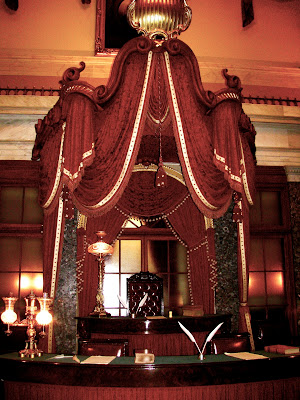
Today, Monday, our class trekked through DC's worst weather yet to get to the Capitol, where we got a wee tour of the Senate Press Gallery, and then worked our way over to the House.
I LOVED our tour guide/director of the Senate Press Gallery, Joe Keenan. I have never seen someone who loves his job SO much. It was eerily contagious - and after 5 minutes I couldn't believe how interested I was in U.S. political history. I was asking all these questions, and getting really into Senate policy, and starting to seriously consider one day becoming myself the director of the gallery.
Then, within about 5 seconds of leaving I realized that I know absolutely nothing about government, politics, or anything relatively related to what such a job would entail.
Anyhow, he was so chatty and into his job - and it was so great how he told us all the funny little quirks about the people who work in government. How Ted Kennedy always sat in the corner so he could be the first to leave, and how one senator had to pee so often during one important hearing that the entire senate & press had to break once an hour - just for him. (I definitely empathized with this fellow, god bless the weak-bladdered).
The best part was the senate desks. First of all, they have this whole rotation system worked out, so seniority determines who gets to choose where to sit. That means the freshman get the crappy desks, while the old folks get all the prime real estate.
Then, every senator who sits in a desk immediately carves his name into it. How colloquial and old-school is that?
There's also a "candy desk", where the occupant is required to have a 24/7 supply of candy inside, one desk that won't open because some senator was making a statement against using constituent tax-dollars to construct new desks with tops that open, and one desk with a bayonet hole through it from when the south seceded and the right half of the room was used as an army hospital.
Honestly, I came away from the whole speech convinced that we never, ever grow up. All the senators just came off looking like big 5 year olds. Freshman corners? Carving names? Bathroom breaks? Candy desks? And this is in the U.S. Senate, the 'elite' group that we elect to rule our dignified nation?
And then Joe Keenan goes on to tell us that the most fun that the reporters ever have is when they get to smoke, drink and order in pizza at 2am in the press gallery? Seriously, am I the only one who gets the mental image that DC is an amalgamation of kindergartners in suits and ties?
Anyhow, despite the freezing cold and rain, it was a nice visit all in all. If nothing else, I've been inspired to get a job that I'm half as passionate about as Joe Keenan was about his.
I've also lost about 80% of my formerly held fear of government officials. Big babies.
I LOVED our tour guide/director of the Senate Press Gallery, Joe Keenan. I have never seen someone who loves his job SO much. It was eerily contagious - and after 5 minutes I couldn't believe how interested I was in U.S. political history. I was asking all these questions, and getting really into Senate policy, and starting to seriously consider one day becoming myself the director of the gallery.
| joe |
Then, within about 5 seconds of leaving I realized that I know absolutely nothing about government, politics, or anything relatively related to what such a job would entail.
Anyhow, he was so chatty and into his job - and it was so great how he told us all the funny little quirks about the people who work in government. How Ted Kennedy always sat in the corner so he could be the first to leave, and how one senator had to pee so often during one important hearing that the entire senate & press had to break once an hour - just for him. (I definitely empathized with this fellow, god bless the weak-bladdered).
| old senate |
The best part was the senate desks. First of all, they have this whole rotation system worked out, so seniority determines who gets to choose where to sit. That means the freshman get the crappy desks, while the old folks get all the prime real estate.
Then, every senator who sits in a desk immediately carves his name into it. How colloquial and old-school is that?
There's also a "candy desk", where the occupant is required to have a 24/7 supply of candy inside, one desk that won't open because some senator was making a statement against using constituent tax-dollars to construct new desks with tops that open, and one desk with a bayonet hole through it from when the south seceded and the right half of the room was used as an army hospital.
Honestly, I came away from the whole speech convinced that we never, ever grow up. All the senators just came off looking like big 5 year olds. Freshman corners? Carving names? Bathroom breaks? Candy desks? And this is in the U.S. Senate, the 'elite' group that we elect to rule our dignified nation?
And then Joe Keenan goes on to tell us that the most fun that the reporters ever have is when they get to smoke, drink and order in pizza at 2am in the press gallery? Seriously, am I the only one who gets the mental image that DC is an amalgamation of kindergartners in suits and ties?
Anyhow, despite the freezing cold and rain, it was a nice visit all in all. If nothing else, I've been inspired to get a job that I'm half as passionate about as Joe Keenan was about his.
I've also lost about 80% of my formerly held fear of government officials. Big babies.
Elementary, My Dear Rosenstiel
I think one of my favorite parts of having people come speak for us is getting to hear what they were going to be before they decided on becoming a journalist.
Tom Rosenstiel apparently lived in the ghetto, had a fro, and was all set to be a musician, when Mike McCurry (future Clinton White House Press Secretary) recruited him to work for the school paper, at which point he "caught the bug" (as so many of these speakers tend to do), and decided to pursue journalism instead.
He eventually went on to be the media critic at the LA Times, a job that people told him would ruin his career. I guess the staff of the paper grows to hate you when you're constantly criticizing them - can't imagine why.
During said 10 year stint, Mr. Rosenstiel decided to mix things up a bit - and instead of debating the current state of the media for pages and pages, he decided to go out and actually get some hard data that would reflect the condition of the news. He was very focused on statistics. In fact, I'm a little bit unsure of where he stores away all of his data. I guess if you do enough speeches you sort of memorize the facts (though I'm not sure this theory works, as the statistics he told us change fairly often.)
Nonetheless, it was really cool to hear all these hard facts backing up the claims he was making. I guess I see the point now in adding some statistical data to your story - definitely beefs it up a bit.
After his time at the LA Times,he went on to be Director for the Project for Excellence in Journalism (something I've heard referenced incessantly here - so it's obviously a pretty big deal in DC journalist world, at least). And THEN (drum roll please) he wrote our beloved class text, "The Elements of Journalism" - which, yes, I have completed in full, thank you very very much.
One of Mr. Rosenstiel's main points was that journalists are no longer "gatekeepers", 'cause there's so much info out there (internet, etc), that they don't decide what we get anymore. He also reiterated something his book stated many times - it is the means and method that should be objective when writing a story, not the ends.
He was also very into having a scientific method for completing journalistic work - something I could have guessed from his love of data.
Another interesting point he had was that people no longer turn specifically to a news organization to get their news, but instead search for a topic, and as a result wind up reading something put out by a news organization. 2/3 of people end up at the New York Times website after a search like Google, as opposed to directly seeking the site out. We don't turn to the newspaper, we actively look for the news, - it's "shifted from a lean back to a lean forward experience"
He also mentioned the love of my life, NPR, saying that its audience has doubled when everyone else's is experiencing problems because (1), we have more drive time, (2), other radio news has decreased, and (3), it provides explanatory journalism - something we've come to like more than straight reporting (for better or for worse...worse, if you agree with the majority of our speakers).
Finally - and I promise this is the last thing, he told us that newspapers have not lost their audience, only their ad revenue. (online newspapers draw a ton of readers). Craigslist sucked the power of the classifieds, there is no longer scarcity so advertisers don't rely on papers, they have their own websites so don't need ads, and they're not following the papers online (here he noted how people hate pop up ads, a revolutionary concept, I assure you, for I don't know about you, but I adore when a giant sparkly iPod suddenly obscures the entire page I'm reading and my computer starts screaming "YOU'VE BEEN CHOSEN TO RECEIVE A FREE IPOD" - especially when I'm in the library and have forgotten to put my volume on mute) ... ahh, precious moments.
WOW. That was much too long of a post - and yet I have even more information I want to write, even if I know that .1% of people made it to this point.
Mr. Rosenstiel had so many cool points and facts and little tidbits of info that I didn't know - so, even if it was the ugliest, rainiest, most freezing day ever, it was still worth walking the arduous 1/2 block to Dunblane to see him.
Sunday, October 3, 2010
WAMU-FM: 88.5
Wednesday we got to hear from some of my all-time favorite rock-star idols : the folks over at NPR - that oh-so-fabulous public organization that consistently refused (well, if we're going to be completely honest, failed to even acknowledge) my several internship applications.
I guess I assumed that my status as a passionate and committed listener would somehow heighten my standing among the endless list of hopeful interns-but we all know how far assuming gets us.
But don't fear, NPR, I have not deserted you. I shall remain a loyal devotee as long as you continue to provide your slightly high brow, but ever-so-intriguing, material, cost-free to us humble plebeian folk back home.
Anyhow, you can imagine how thrilled I was Wednesday to be able to share the same air space with these legendary and elusive elite, even if the chairs in said space were packed so unnecessarily close to one another to make for some lovely and considerably uncomfortable shared moments between me and the random girl seated next to me. (awkward shoulder brush, anyone?)
Susanne Reber, NPR Deputy Managing Editor of Investigations, and Keith Jenkins, Senior Supervising Producer for NPR Multimedia, along with Kathy Kiely who works for USA Today, talked with us about journalism and new media - a topic we've heard nothing about thus far. (note the sarcasm)
They made some interesting points, about having to be a "lifetime learner", and how the medium should be driven by the story. Ultimately, the theme seemed to be to not let technology or new media determine what the story should be, but instead adapt the technology in whatever way will best tell your story.
Quality over quantity came up again and again. Don't just throw together whatever bits of multimedia you can, but really think through how best to present your topic and subjects. "Just because you can do it, doesn't mean you should."
The people from NPR then gave us some good examples of the types of unique stories that NPR investigates, and why it is different from so many other news organizations and outlets. For example, instead of focusing on the BP oil spill, they decided to find a blast survivor and tell his story. And instead of leaving the Virginia coal mine when the hard news story began to die out like all the other reporters, they stuck around to gain the trust and respect of the community, and are now better able to investigate the causes behind the tragedy.
They focused most, however, on their recent "Brain Wars" series, a look into the brain damage that returning soldiers suffer and how it's been largely ignored by doctors, psychologists and most other organizations - to the enormous detriment of the soldiers. (see it here: http://www.npr.org/templates/story/story.php?storyId=127402851)
It was really eye-opening to see the amount of work that goes on to produce such a comprehensive story; first researching the best "character", then building a relationship with the subject, choosing the right media to document his struggle, finding supplementary footage and images, editing it all together and eventually designing a web page to support the carefully assimilated material (and don't think that just because they're this prestigious organization that they're not plotting and planning and devising the best ways to increase web-hits like the rest of 'em, because they certainly are).
I came away from the little forum just salivating at how cool it would be to work for someplace like NPR. You'd have all of these resources allotted to you (not to mention the NPR name to throw around) with this expectation that you are going to create a news piece different from anything else the other mainstream news outlets are producing. Your story is going to have a deeper meaning, and it's going to delve into issues that go beyond the hard news to find the underlying concerns and the affected parties - It won't just stop at the who, what & where - but really examine the how & why.
*sigh*
and thus I reluctantly end my ode to NPR (and don't think I'm not aware of how desperate I sound - because I very very very much am) to retire to the comfort of Netflix Instant Play - after all, there's nothing a good episode of Veronica Mars can't fix.
Cheerio mate
I guess I assumed that my status as a passionate and committed listener would somehow heighten my standing among the endless list of hopeful interns-but we all know how far assuming gets us.
But don't fear, NPR, I have not deserted you. I shall remain a loyal devotee as long as you continue to provide your slightly high brow, but ever-so-intriguing, material, cost-free to us humble plebeian folk back home.
Anyhow, you can imagine how thrilled I was Wednesday to be able to share the same air space with these legendary and elusive elite, even if the chairs in said space were packed so unnecessarily close to one another to make for some lovely and considerably uncomfortable shared moments between me and the random girl seated next to me. (awkward shoulder brush, anyone?)
Susanne Reber, NPR Deputy Managing Editor of Investigations, and Keith Jenkins, Senior Supervising Producer for NPR Multimedia, along with Kathy Kiely who works for USA Today, talked with us about journalism and new media - a topic we've heard nothing about thus far. (note the sarcasm)
They made some interesting points, about having to be a "lifetime learner", and how the medium should be driven by the story. Ultimately, the theme seemed to be to not let technology or new media determine what the story should be, but instead adapt the technology in whatever way will best tell your story.
Quality over quantity came up again and again. Don't just throw together whatever bits of multimedia you can, but really think through how best to present your topic and subjects. "Just because you can do it, doesn't mean you should."
The people from NPR then gave us some good examples of the types of unique stories that NPR investigates, and why it is different from so many other news organizations and outlets. For example, instead of focusing on the BP oil spill, they decided to find a blast survivor and tell his story. And instead of leaving the Virginia coal mine when the hard news story began to die out like all the other reporters, they stuck around to gain the trust and respect of the community, and are now better able to investigate the causes behind the tragedy.
They focused most, however, on their recent "Brain Wars" series, a look into the brain damage that returning soldiers suffer and how it's been largely ignored by doctors, psychologists and most other organizations - to the enormous detriment of the soldiers. (see it here: http://www.npr.org/templates/story/story.php?storyId=127402851)
It was really eye-opening to see the amount of work that goes on to produce such a comprehensive story; first researching the best "character", then building a relationship with the subject, choosing the right media to document his struggle, finding supplementary footage and images, editing it all together and eventually designing a web page to support the carefully assimilated material (and don't think that just because they're this prestigious organization that they're not plotting and planning and devising the best ways to increase web-hits like the rest of 'em, because they certainly are).
I came away from the little forum just salivating at how cool it would be to work for someplace like NPR. You'd have all of these resources allotted to you (not to mention the NPR name to throw around) with this expectation that you are going to create a news piece different from anything else the other mainstream news outlets are producing. Your story is going to have a deeper meaning, and it's going to delve into issues that go beyond the hard news to find the underlying concerns and the affected parties - It won't just stop at the who, what & where - but really examine the how & why.
*sigh*
and thus I reluctantly end my ode to NPR (and don't think I'm not aware of how desperate I sound - because I very very very much am) to retire to the comfort of Netflix Instant Play - after all, there's nothing a good episode of Veronica Mars can't fix.
Cheerio mate
| Kathy Kiely & student |
| Susanne Reber |
| sorry, man, this one made me laugh too hard not to add it |
| Keith Jenkins - I loved his glasses |
Saturday, October 2, 2010
Clouds... strange clouds.
Wingapo
and Oh. my. goodness. I just finished reading my terribly awfully horribly boring book for class. Admittedly, it's a very comprehensive and detailed outline of the thought processes and moralistic behavior that should taken into consideration when pursuing a journalistic career.
Regrettably, it's no Harry Potter.
All truly worthy books require one or two good quality spells to spice things up a bit, wouldn't you agree?
Or a three-headed dog.
Or butterbeer.
mmmm. Butterbeer sounds so good right now (even if I'm fairly certain I have no idea what butterbeer actually is). So does apple-picking. I LOVE fall. I love all the wonderful things about it. I love really badly carved pumpkins and dorky-non-revealing-totally-asexual costumes and leaf piles (one of which I made a valorous attempt to jump into today, before being alerted by my slightly more practical roommate that not only was I in a public place, but in the middle of a busy street surrounded by pedestrians and speeding cars).
Alas! it's OK! And whyy, might you ask, is my thwarted attempt at a return to a childhood happy place causing such a disconcertingly small amount of emotional scarring?
Because, my dear companions, I am going to be Pocahontas for Halloween! (if all goes as planned and I don't catch pneumonia or fall or have an exam or just decide to be lazy).
Today my roommate and I walked into a Halloween store in Georgetown, and I was astounded by the number of Native American costumes they had - and also by how wonderfully politically correct they all were! Of course Indian princesses wore sweetheart-topped fringe laden mini dresses, complete with precariously placed loin clothes and ruched bodices! Obbbbvviously they had nothing more important to concern themselves with than the deep-v plunge of their strategically revealing attire.
Let it be known that I will not be wearing one of these generic store offerings, but conjuring up some totally earthly-inspired little do-op of my own, -
for I channel the colors of the wind.
Georgetown Halloween is, as rumor has it, a pretty big shin-dig, so I'm looking forward to flaunting my fringe-laden (or possibly non-fringe laden, depending on how ambitious I attempt to be) frock for the DC world to see. Watch out stuffy politician and executive bound Washingtonians, your earth-child neighbor is preparing to bust out the Que que na-to-ra so highly recommended by Grandmother Willow and to follow her dream-giver just around the riverbend.
(can I cram in one more Disney reference?? can I do it? can I?!?)
Ana.
(did it)
and Oh. my. goodness. I just finished reading my terribly awfully horribly boring book for class. Admittedly, it's a very comprehensive and detailed outline of the thought processes and moralistic behavior that should taken into consideration when pursuing a journalistic career.
Regrettably, it's no Harry Potter.
All truly worthy books require one or two good quality spells to spice things up a bit, wouldn't you agree?
Or a three-headed dog.
Or butterbeer.
mmmm. Butterbeer sounds so good right now (even if I'm fairly certain I have no idea what butterbeer actually is). So does apple-picking. I LOVE fall. I love all the wonderful things about it. I love really badly carved pumpkins and dorky-non-revealing-totally-asexual costumes and leaf piles (one of which I made a valorous attempt to jump into today, before being alerted by my slightly more practical roommate that not only was I in a public place, but in the middle of a busy street surrounded by pedestrians and speeding cars).
Alas! it's OK! And whyy, might you ask, is my thwarted attempt at a return to a childhood happy place causing such a disconcertingly small amount of emotional scarring?
Because, my dear companions, I am going to be Pocahontas for Halloween! (if all goes as planned and I don't catch pneumonia or fall or have an exam or just decide to be lazy).
Today my roommate and I walked into a Halloween store in Georgetown, and I was astounded by the number of Native American costumes they had - and also by how wonderfully politically correct they all were! Of course Indian princesses wore sweetheart-topped fringe laden mini dresses, complete with precariously placed loin clothes and ruched bodices! Obbbbvviously they had nothing more important to concern themselves with than the deep-v plunge of their strategically revealing attire.
Let it be known that I will not be wearing one of these generic store offerings, but conjuring up some totally earthly-inspired little do-op of my own, -
for I channel the colors of the wind.
Georgetown Halloween is, as rumor has it, a pretty big shin-dig, so I'm looking forward to flaunting my fringe-laden (or possibly non-fringe laden, depending on how ambitious I attempt to be) frock for the DC world to see. Watch out stuffy politician and executive bound Washingtonians, your earth-child neighbor is preparing to bust out the Que que na-to-ra so highly recommended by Grandmother Willow and to follow her dream-giver just around the riverbend.
(can I cram in one more Disney reference?? can I do it? can I?!?)
Ana.
(did it)
Subscribe to:
Posts (Atom)